Abstract
Topology provides a framework for describing phases of matter whose distinction is encoded not only in local properties, but also in the global structure of their quantum states. In crystalline systems, the electronic structure is described by a family of Bloch Hamiltonians $H(\mathbf{k})$ defined over the Brillouin zone. The corresponding Bloch eigenstates vary throughout momentum space and thereby define a geometric structure that can be described in terms of vector bundles, Berry connections, and Berry curvature. This geometric viewpoint gives rise to topological invariants such as Chern numbers, which play a central role in the classification of topological band structures.
In three-dimensional systems, topological phases can arise whose characterization goes beyond Chern numbers. An important example is the Hopf insulator, whose topology is associated with the homotopy class of the Bloch states over the three-dimensional Brillouin zone and can be characterized by an integer-valued Hopf invariant. In contrast to stable topological phases, the Hopf insulator provides an example of delicate topology, for which the topological classification depends on keeping the number of occupied and unoccupied bands fixed.
A geometric formulation of this three-dimensional topology can be obtained by extending the familiar Berry connection to a higher-form gauge structure. This higher-form structure is naturally related to bundle gerbes, which provide a higher-degree generalization of line bundles. Just as line bundles are associated with a degree-two characteristic class, bundle gerbes are associated with the Dixmier-Douady class in $H^3(M,\mathbb{Z})$.
In this thesis, we build on the work of Jankowski et al. We reconstruct the tensor Berry connection for the three-band Hopf insulator and derive explicitly the relation between the Dixmier-Douady and Hopf invariants.
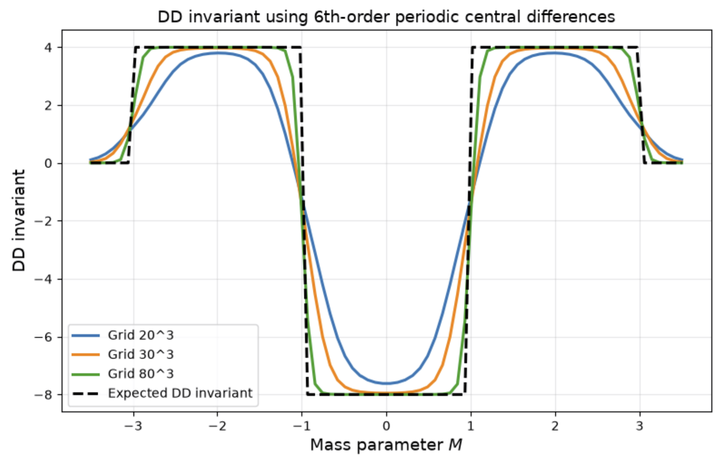
Further, we develop a formulation of the Dixmier-Douady invariant that is suitable for numerical calculations. Expressions written directly in terms of Bloch eigenstates can be inconvenient numerically because eigenvectors obtained from diagonalization contain arbitrary gauge choices. Band projectors, in contrast, are invariant under momentum-dependent phase transformations of the eigenstates and therefore provide a manifestly gauge-invariant description of the band geometry. We therefore reproduce the projector expression for the ordinary Berry curvature and derive an analogous expression for its higher-form generalization. These expressions provide the basis for a numerical calculation of the Dixmier-Douady invariant on a discretized three-dimensional Brillouin zone.
The remainder of this work is organized in three parts. We first introduce the mathematical framework of bundle gerbes and the Dixmier-Douady class and connect it to the topology of crystalline band structures. We then construct the tensor Berry connection, establish the relation between the Dixmier-Douady and Hopf invariants, and derive a gauge-invariant projector formulation. Finally, we apply these results to explicit three-band Hamiltonians, studying both analytical and numerical calculations of the invariant.
